 Motorcyclists across the United States need to pay attention to what is happening in Florida right now. Not because most riders are criminals—far from it—but because Florida has a long history of becoming a testing ground for laws that later spread nationwide. Special thanks to Kathryn from Bikers Across the Nation who presented a great article about what is going on in Florida. To read more from them please visit their website by clicking here.
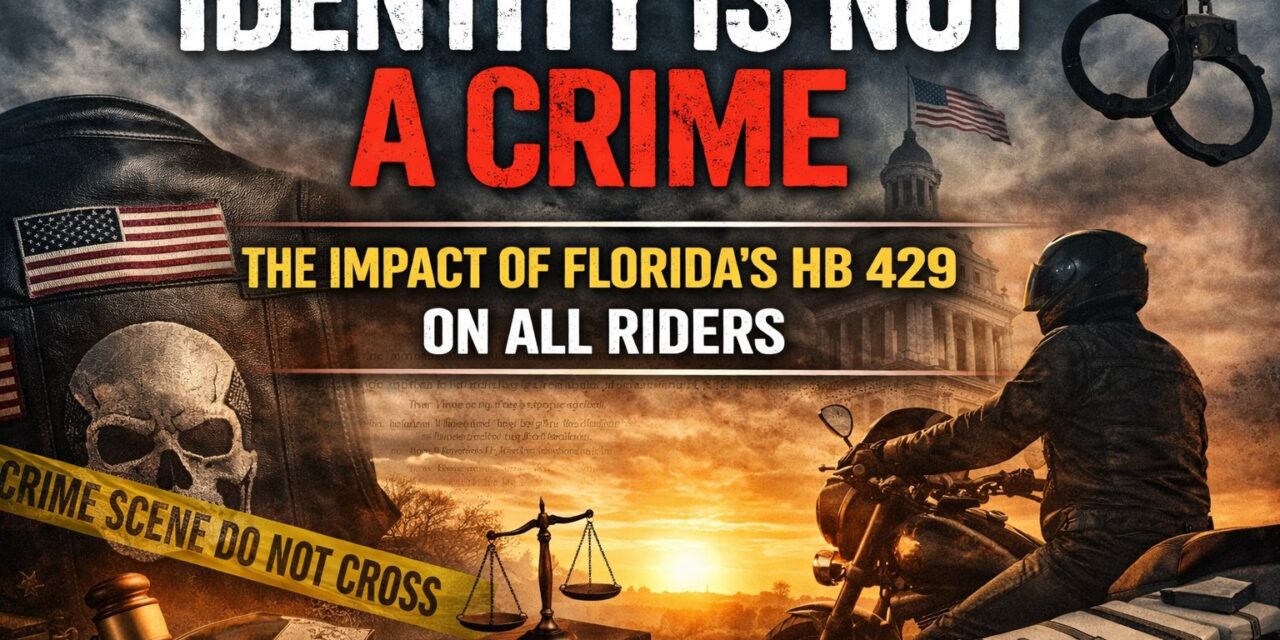
Florida’s CS/HB 429 is being sold as a public-safety measure aimed at criminal gangs. On paper, it sounds distant from everyday riders. The word “biker” never appears in the bill. But when you look closely at how the law defines “gang-related” activity, it becomes clear that this legislation reaches far beyond violent crime—and directly into how people dress, speak, associate, and express themselves.
This is not just a club issue. It is a rider issue.
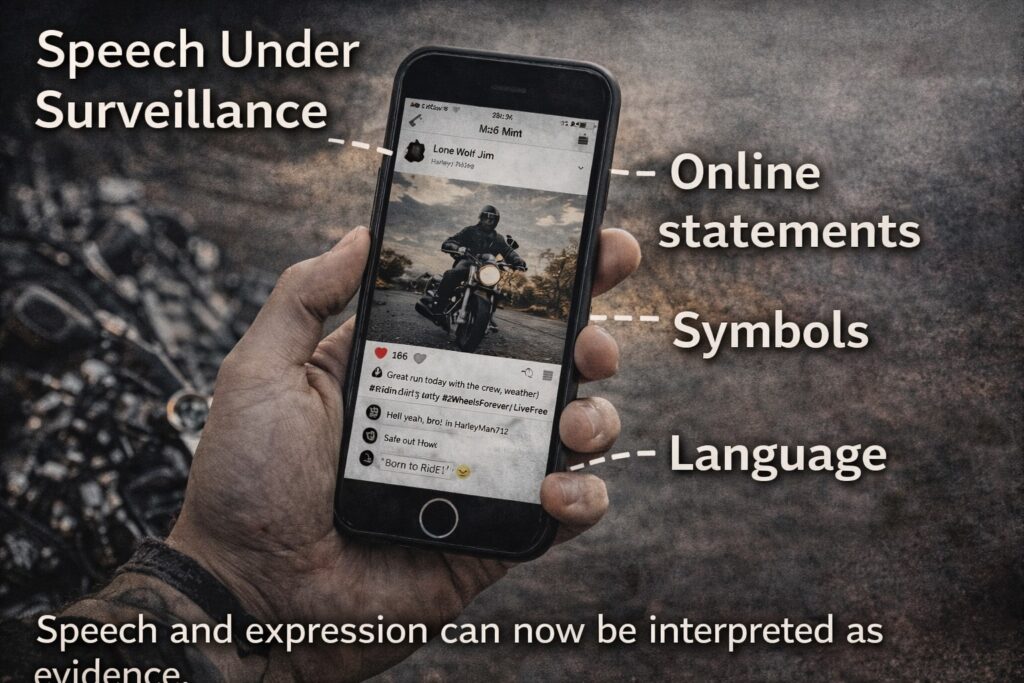 When identity starts to matter more than behavior
Under Florida law, a “criminal gang member” is defined as someone who meets two or more listed criteria. HB 429 expands what counts as those criteria in ways that should concern anyone who values personal freedom.
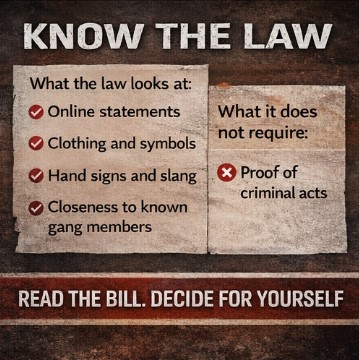
A person may now be labeled a criminal gang member if they:
-
Admit—in person or online—to being associated with a gang
-
Are “identified or claimed” by a gang as a member
-
Are identified by a parent, guardian, or spouse
-
Are identified by an informant, even one whose reliability has not been previously tested
-
Wear clothing, symbols, or tattoos associated with a gang
-
Use certain hand signs or language
-
Associate with known gang members or are seen with them two or more times
Notice what is missing from that list: a requirement to commit a crime.
Under this framework, identity markers and associations can carry legal weight, even without proof of criminal behavior. That is a profound shift in how suspicion works under the law.
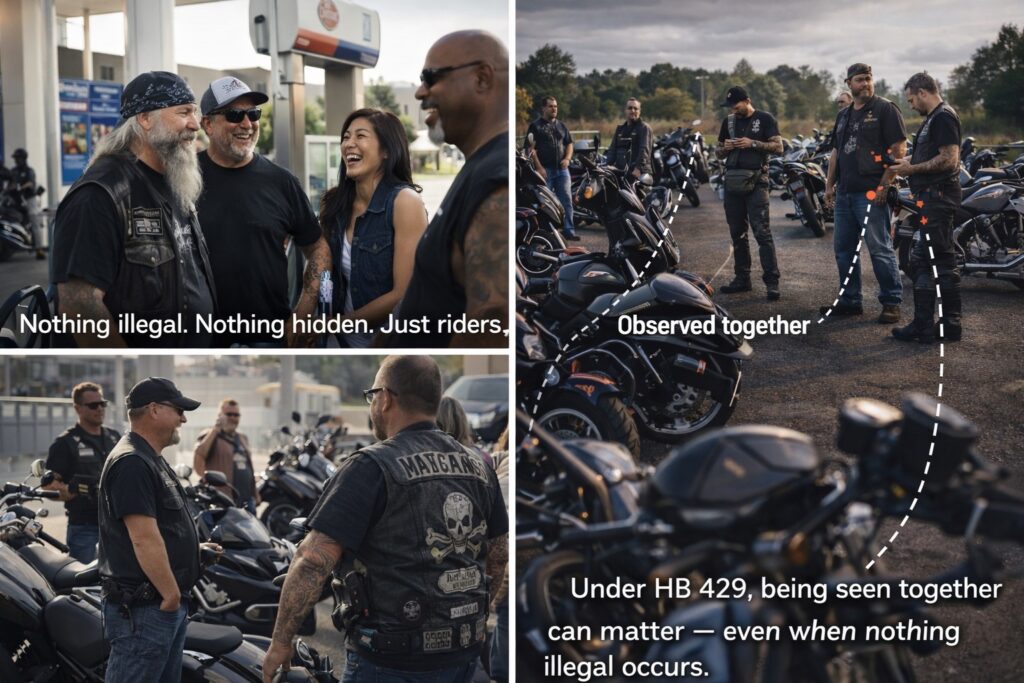 Why this matters to everyday riders
Most motorcyclists are not part of outlaw clubs. Many ride solo, in small groups, or in informal riding circles. But riders share some things in common that this bill places under scrutiny:
-
Distinctive clothing
-
Patches, logos, or symbols
-
Tattoos
-
Group rides
-
Memorial rides, charity events, and bike nights
-
Posting ride photos or jokes online
None of these things are crimes. They are normal parts of motorcycle culture.
Under HB 429, however, appearance and association can be reinterpreted as evidence, especially when combined with online posts or proximity to the “wrong” people. A single photo, comment, or ride could potentially satisfy multiple criteria at once. The bill even specifies that one act can count multiple times, meaning evidence can be “stacked” without additional behavior.
That should concern riders who believe freedom includes the right to express themselves without fear of misclassification.
Speech and social media are now part of the equation
The bill explicitly includes online platforms and social media. It defines “gang-related language” broadly as any statement, written or spoken, that signals affiliation or uses recognized codes, symbols, or terminology.
This creates a chilling effect.
Motorcyclists already joke, exaggerate, use slang, and post bravado online. Most of it is harmless. But when laws begin to treat speech and symbolism as suspicious by default, people start self-censoring—not because they did anything wrong, but because the risk becomes unpredictable.
That is not how free societies are supposed to function.
Guilt by proximity is not justice
Another major expansion in this bill is association. Being observed with a known gang member two or more times can now contribute to a criminal gang designation.
For riders, this is especially dangerous. Motorcycle communities overlap. Events are public. Riders from different backgrounds and affiliations often share the same roads, gas stations, restaurants, rallies, and charity events.
Proximity does not equal criminal intent.
But under this law, being seen together can be enough to raise suspicion, regardless of context. That is not evidence-based policing—it is assumption-based profiling.
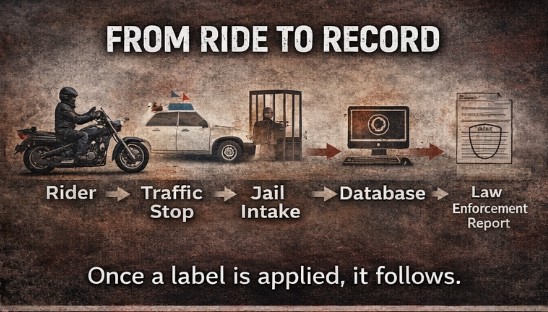 The consequences are serious
This is not just about investigations. These definitions are directly tied to Florida’s harshest penalties.
Being labeled a criminal gang member can:
-
Increase sentencing severity
-
Serve as an aggravating factor in capital cases
-
Follow a person into jail classification systems
-
Be shared repeatedly with law enforcement
-
Become part of permanent institutional records
Once someone is labeled, it is extremely difficult to undo. That label can shape how officers, prosecutors, judges, and jail staff treat a person moving forward.
Identity becomes destiny.
This is exactly what the Constitution was designed to prevent
The First Amendment protects speech, expression, and association. The Fourth Amendment protects against suspicion without evidence. The Fifth and Fourteenth Amendments guarantee due process and equal protection.
These protections exist because history has shown—again and again—how easily governments slip into punishing people for who they are rather than what they do.
The Founders themselves were once labeled radicals, criminals, and threats to public order. They organized in groups, used symbols, published controversial speech, and were surveilled by the Crown. The Constitution was written to prevent that exact abuse of power.
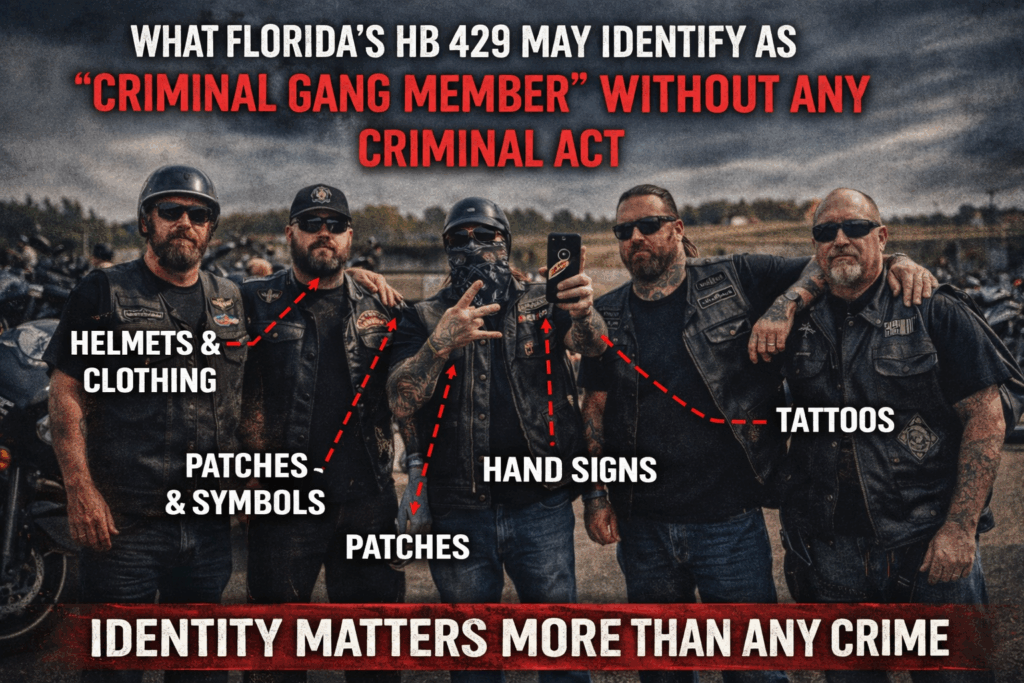 Profiling doesn’t require hatred—only permission
Laws like HB 429 do more than expand enforcement tools. They train the human mind.
When fear and authority mix, people rely on shortcuts. Symbols become threats. Groups become suspect. Individual judgment gives way to category-based assumptions. Profiling does not require bad intentions—it only requires legal permission.
That is why restraint matters. A law that depends on perfect judgment in an imperfect system is not a safe law.
Why riders should care now
Florida has one of the largest motorcycle communities in the country. Riding is visible and year-round. What happens here will not stay here.
If laws that treat appearance, speech, and association as suspicious are accepted quietly for one group, they become available for use against others. That is how rights erode—not all at once, but piece by piece.
Awareness is not fear. It is responsibility.
 What you can do
Read the bill yourself.
Talk to others about it.
Contact Florida legislators if you live there—or pay attention if similar laws appear in your state.
Motorcycling has always represented freedom, independence, and individuality. Laws that blur the line between identity and criminality threaten more than clubs. They threaten the culture that draws people to two wheels in the first place.
Identity is not a crime. And it shouldn’t be treated like one.

Sources & Further Reading
Readers are encouraged to review the primary sources directly and draw their own conclusions.
-
Florida CS/HB 429 (2026) – Committee Substitute Bill Text (c1)
Full statutory language expanding the definition of “criminal gang member,” including criteria related to speech, appearance, association, informants, and online activity.
Florida Senate:
https://www.flsenate.gov/Session/Bill/2026/429/BillText/c1/PDF -
Florida Statutes § 874.03 – Definitions (Criminal Gangs)
Statutory definition of “criminal gang” and “criminal gang member,” as amended by CS/HB 429.
https://www.leg.state.fl.us/statutes/index.cfm?App_mode=Display_Statute&Search_String=&URL=0800-0899/0874/Sections/0874.03.html -
Florida Statutes § 921.141 – Capital Sentencing Factors
Lists aggravating factors in capital cases, including commission of a felony by a “criminal gang member” as defined in § 874.03.
https://www.leg.state.fl.us/statutes/index.cfm?App_mode=Display_Statute&URL=0900-0999/0921/Sections/0921.141.html -
Florida Statutes § 951.23 – County and Municipal Detention Facilities
Authorizes jail classification systems, including identification and reporting of alleged criminal gang members or associates to law enforcement.
https://www.leg.state.fl.us/statutes/index.cfm?App_mode=Display_Statute&URL=0900-0999/0951/Sections/0951.23.html -
U.S. Constitution – Amendments I, IV, V, and XIV
Protections for speech, expression, association, due process, and equal protection.
National Archives:
https://www.archives.gov/founding-docs/bill-of-rights-transcript
https://www.archives.gov/founding-docs/amendments-11-27 -
U.S. Supreme Court & Federal Court Precedent on Gang Enhancements and Association
-
NAACP v. Claiborne Hardware Co., 458 U.S. 886 (1982) — limits guilt by association
-
City of Chicago v. Morales, 527 U.S. 41 (1999) — vagueness in gang-related statutes
-
United States v. Jones, 565 U.S. 400 (2012) — evolving Fourth Amendment concerns
(Readers are encouraged to explore how courts have scrutinized laws that rely on identity, association, or vague standards.)
-
-
Historical Context and Reform Efforts
-
California STEP Act reforms
-
Illinois gang database audits
-
Federal reviews of informant reliability and due process concerns
(Public records and legislative histories available through state legislative archives.)
-
Note to Readers
Laws do not operate only as written. They operate as interpreted, enforced, and normalized. Reading the source material is the first step in understanding how policy decisions affect real people and real communities.